

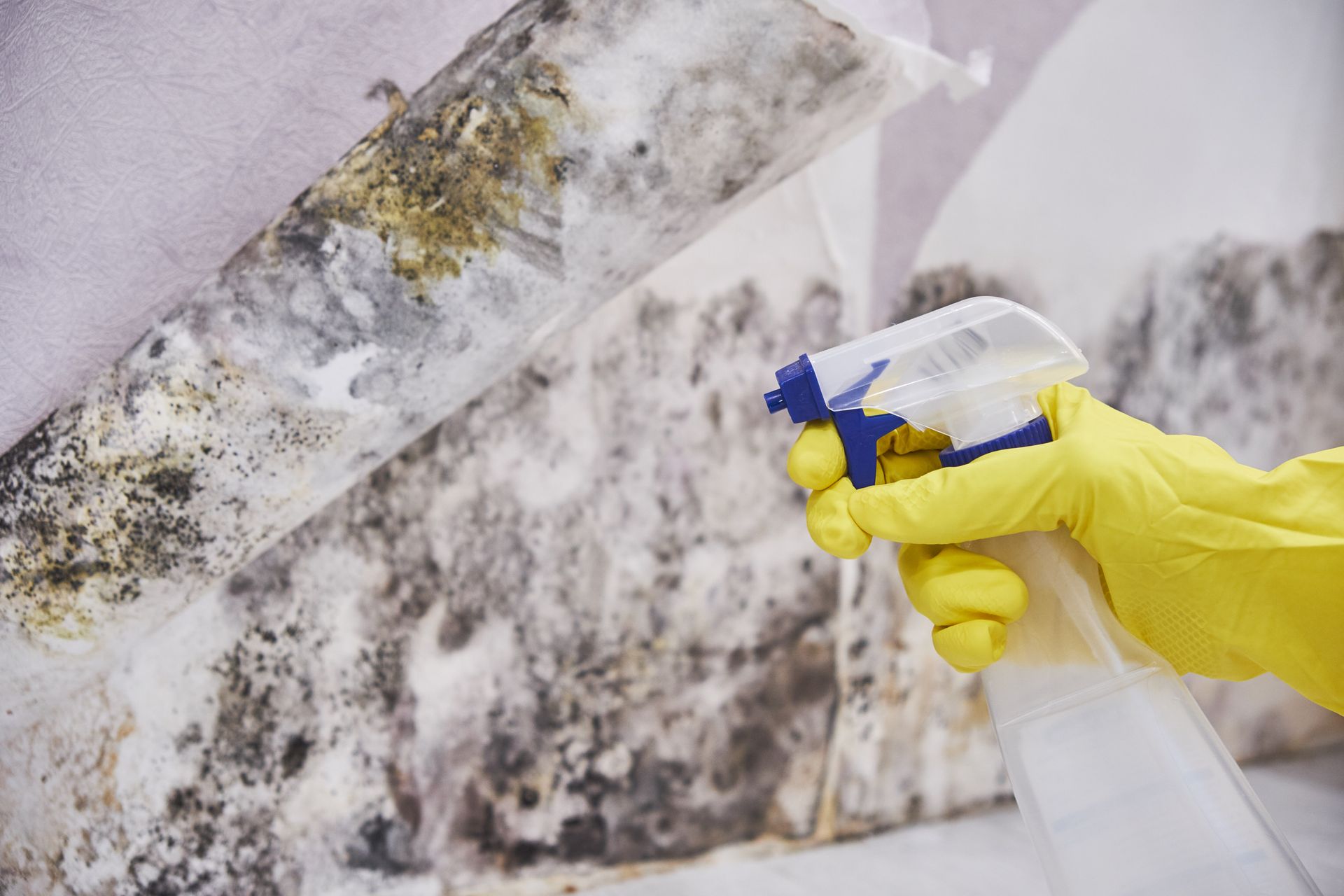
Mould rarely announces itself. The first signs of mould in your house after a stretch of summer rain are usually subtle: a faint earthy smell in the basement, a shadow along a baseboard, wallpaper that no longer sits flat. Catch those signs in the first days and cleanup is often a small job. Miss them for a few weeks and you may be looking at drywall replacement instead of a bucket and detergent.
Why late summer is prime mould season indoors
Mould needs three things to grow: spores, a food source, and moisture. The first two are already in every home, since spores are a natural part of the air and materials such as drywall, wood, paper, and carpet underlay are all food. Late summer supplies the third ingredient in abundance. Warm air holds more water vapour, repeated rain keeps the ground around the foundation saturated, and humid outdoor air drifts into cool basements where it condenses on concrete and cold water pipes.
Health Canada advises running a dehumidifier when indoor relative humidity climbs above 50 percent, and in a rainy August many Canadian basements sit above that line for days at a time without anyone noticing. An inexpensive hygrometer, placed in the basement, is the simplest early-warning device a homeowner can buy.
What are the first signs of mould in your house?
Your nose usually finds mould before your eyes do. A musty, earthy odour, often compared to wet leaves or an old book, is frequently the first indication, and Health Canada's guidance treats odour seriously: rate the mustiness in each room as mild, moderate, or strong, and take immediate action with professional help if any room rates strong. A smell that intensifies when the air conditioning has been off, or that greets you at the top of the basement stairs, deserves investigation even if nothing is visible.
Visible signs come next. Mould typically appears as spots, stains, or fuzzy and powdery patches, in colours ranging from black and green to brown, grey, or white. It is easy to dismiss early growth as dirt or shadow, so look twice at any discolouration that was not there last month.
The third category is what mould does to materials around it. Peeling or bubbling wallpaper, blistering paint, warped baseboards, and lifting vinyl flooring all signal trapped moisture, and where moisture has been trapped for more than a few days, mould is usually already growing behind the surface.
Where mould hides after heavy rain
Health Canada notes that mould growth can be hidden, growing behind walls or above ceiling tiles, and recommends checking anywhere that is damp, especially where water damage has occurred. After a wet late summer, the spots technicians check first are the ones homeowners rarely look at: the wall behind furniture pushed against an exterior wall, where air cannot circulate; the underside of carpet and underlay in a basement that took in even a small amount of water; the back of closets on outside walls; the drywall below window sills that leaked during wind-driven rain; and the ceiling below any bathroom or roof area that has had a leak. Pull furniture away from exterior walls once and look; the ten-minute check costs nothing.
How much mould can you clean yourself?
Health Canada sizes the job by area, and the thresholds are specific. A mould problem is small if there are no more than three patches and the total area is one square metre or less, roughly a garbage bag folded in half. Small areas can be cleaned by the homeowner using water and dish detergent, wearing rubber gloves, safety glasses, and a disposable N95 mask. A problem is medium if there are more than three patches but the combined area stays under three square metres; a professional assessment is recommended, though careful cleanup is often still possible. A single patch larger than three square metres is a large problem, and Health Canada recommends a qualified professional assess and clean it.
Two points from that guidance surprise most homeowners. First, there is no need to use bleach; detergent and water do the job, and Health Canada's homeowner guidance says plainly not to use bleach on mould. Second, scrubbing is not always the right move. Aggressive cleaning of a large or porous mouldy surface can release spores into the air and spread the problem to rooms that were clean. A spray bottle and gloves are the right tools for a small patch on a hard surface, not for a wall of soaked drywall.
When the job needs a professional
Health Canada identifies specific situations that call for a qualified professional regardless of the visible size: mould that returns after cleaning, which means the moisture source was never fixed; suspected hidden mould inside walls or above ceilings; flooding that penetrated wall or floor cavities; and any water that was contaminated with sewage. Professional restoration teams also bring what the eye cannot: moisture meters and thermal imaging that find dampness inside a wall assembly before it becomes visible growth, which is often the difference between drying a wall and rebuilding it.
If the musty smell will not go away, if the patch keeps coming back, or if you suspect the rain got somewhere it should not have, Paul Davis is ready to help. Our Emergency Response Promise means we will contact you within 30 minutes of your call, we are onsite within hours, we document your process thoroughly, and we serve you with empathy and concern for your situation. Call 1-800-661-5975 or find your local Paul Davis, with 65+ locations across Canada.
Frequently asked questions
What does mould smell like in a house?
Mould produces a musty, earthy odour, often compared to wet leaves, damp soil, or old paper. The smell tends to be strongest in still air, such as a basement or a closed room, and Health Canada advises taking immediate action with professional help if the musty odour in any room is strong.
How much mould can I safely clean myself?
Health Canada considers a mould area small if there are no more than three patches totalling one square metre or less; homeowners can clean small areas with water and dish detergent while wearing gloves, eye protection, and an N95 mask. A single patch larger than three square metres calls for a qualified professional. Do not use bleach.
Why does mould keep coming back after I clean it?
Mould returns because the moisture feeding it was never removed; cleaning the surface does nothing about a leak, condensation, or damp wall cavity behind it. Health Canada lists recurring mould as one of the situations that requires a qualified professional, since finding and fixing the hidden moisture source is the real repair.

Our Emergency Response Promise
Paul Davis franchisees across Canada are ready to respond to your property damage, 24/7.
We'll contact you within 30 minutes of your call
We’re onsite within hours
We document your process thoroughly
We serve you with empathy and concern for your situation
