

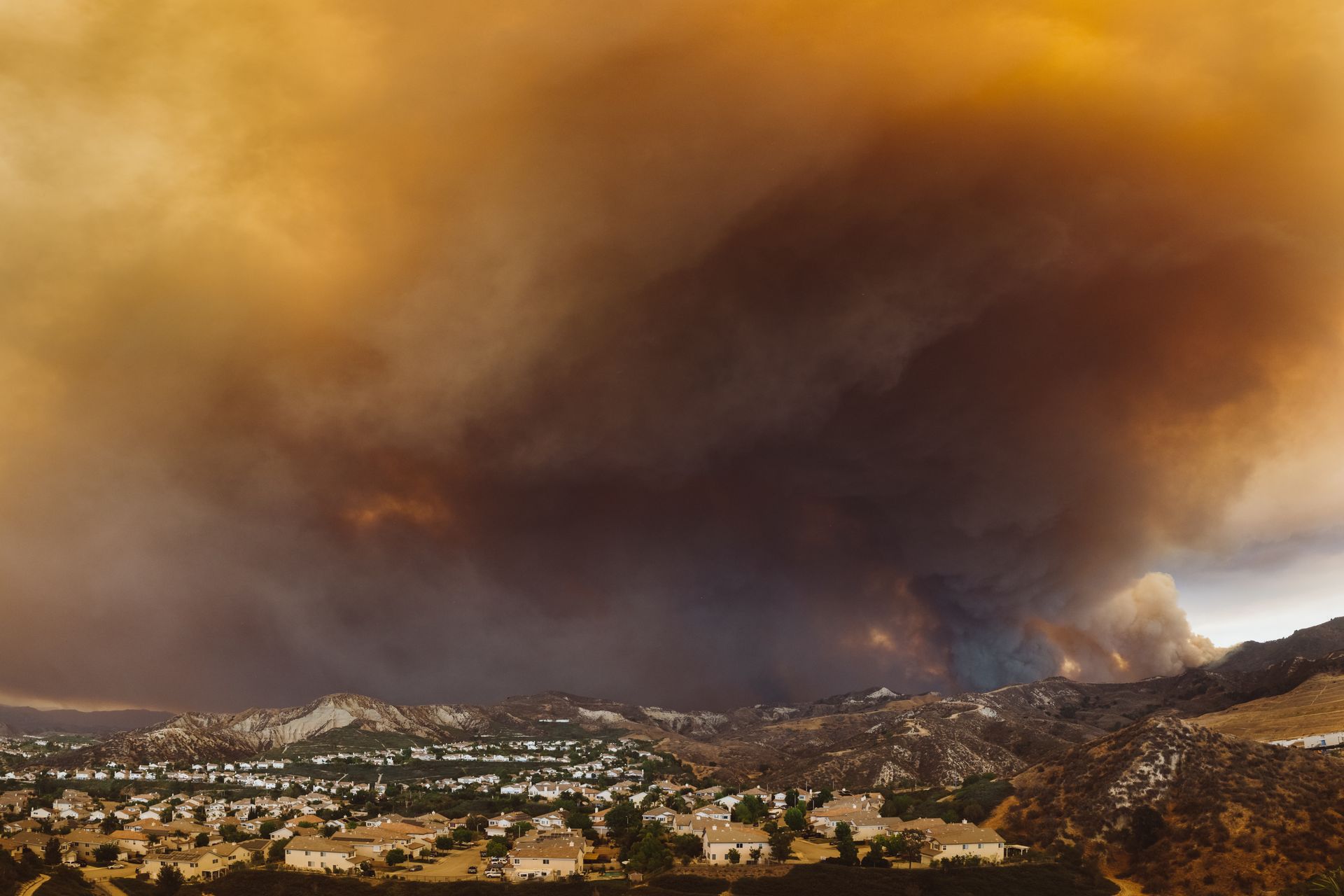
When wildfire smoke rolls in, the air inside your home can turn hazardous before you ever see haze.
Protecting your home from wildfire smoke comes down to two things: keeping fine particles out, and filtering the ones that get in anyway. Here is how to do both — and why it matters across Canada.
Smoke travels far. According to Health Canada, it can drift hundreds or thousands of kilometres from the fire, so your home can fill with smoke even when the nearest flames are provinces away. Natural Resources Canada recorded 2023 as the most destructive wildfire season in Canadian history, with roughly 16.5 million hectares burned — a reminder that smoky summers are now a national reality, not a regional one.
Why wildfire smoke is a health risk
The most harmful part of wildfire smoke is invisible: fine particulate matter called PM2.5, particles far thinner than a strand of hair that travel deep into the lungs and pass into the bloodstream. Health Canada is blunt — there is no safe level of exposure. Effects range from sore throats and headaches to serious breathing trouble for people with asthma, COPD, or heart conditions. Young children, older adults, pregnant people, and anyone with a heart or lung condition feel it first, so if someone in your home is in one of those groups, make indoor air a priority.
How to keep wildfire smoke out of your home
Smoke does not need an open window — it seeps through the same gaps that leak heat in winter: worn weatherstripping, cracked caulking, unsealed attic hatches, and exhaust vents. When a smoke advisory is issued, close all windows and doors and switch off anything that pulls outdoor air inward, including bathroom and kitchen fans and any "fresh air intake" setting on your ventilation system. Then close the obvious leaks — fresh weatherstripping where the old foam has flattened, a rolled towel at a drafty threshold, and new caulking around aging window frames.
Filter the air you cannot keep out
Sealing slows smoke down; filtration removes what still gets through. A portable air cleaner with a true HEPA filter is the most effective tool for a single room — pick one rated for the room's size, set it where you spend the most time, and run it continuously. If you have forced-air heating or central air conditioning, fit a high-efficiency filter (ideally MERV 13, the rating Health Canada points to for capturing fine smoke particles) and set the system to recirculate indoor air rather than draw in outdoor air. Check the filter often, because it clogs far faster during a smoke event.
Use the AQHI to know when to act
Canada's Air Quality Health Index (AQHI) is the simplest way to tell when smoke is a problem: 7 to 10 is high risk, and above 10 is very high risk. In Quebec, the equivalent tool is InfoSmog. Seal up and run your filtration when readings climb, and air the house out once they drop. Trust your nose, too — monitoring stations are not always close by, so smelling smoke indoors is reason enough to close up and filter.
Prepare before the smoke arrives
July sits in the middle of Canada's wildfire season, which Health Canada notes runs roughly from early April to late October. Prepare ahead: keep spare HEPA and MERV-13 filters on hand, along with NIOSH-certified N95 or KN95 respirators for anyone who must go outside. Health Canada notes that cloth masks and bandanas do not filter smoke, and that even a respirator does not protect against the gases in smoke. Pick one room as a clean-air space, and identify a nearby cleaner-air location — a library, community centre, or mall — for anyone medically vulnerable if your home cannot keep up.
Frequently asked questions
Can wildfire smoke get into my house even with the windows closed?
Yes. Fine smoke particles seep through small gaps around doors, windows, vents, and aging caulking, so closed windows reduce indoor smoke without eliminating it. Sealing those leaks and running a HEPA air cleaner together keep indoor levels far lower than sealing alone.
Do air purifiers actually help with wildfire smoke?
Yes. A portable air cleaner with a true HEPA filter captures the fine PM2.5 particles that make up most of wildfire smoke. Choose one rated for your room size and run it continuously — a single unit can keep one bedroom or living room noticeably clearer.
How do I get the smoke smell out of my house afterward?
Light odours often fade once you air the house out and wash fabrics after the AQHI improves. A heavier, lingering smell usually means residue trapped in HVAC ducts and soft surfaces, which needs a thorough professional cleaning to fully remove rather than mask.
When you need help, Paul Davis is here
A smoke event can leave residue in your ducts, ash on surfaces, and odour that is hard to clear on your own — and you do not have to. For nearly sixty years, Paul Davis has helped Canadians recover from fire, water, wind, and smoke, with 65+ locally owned locations responding 24/7. When you call, we contact you within 30 minutes, arrive on-site within hours, document your process thoroughly, and serve you with empathy. If wildfire smoke has affected your home or business, call
1-800-661-5975 or find your local Paul Davis today.

Our Emergency Response Promise
Paul Davis franchisees across Canada are ready to respond to your property damage, 24/7.
We'll contact you within 30 minutes of your call
We’re onsite within hours
We document your process thoroughly
We serve you with empathy and concern for your situation
